
What Is Linux Programming? Complete Guide for Beginners | ETDA
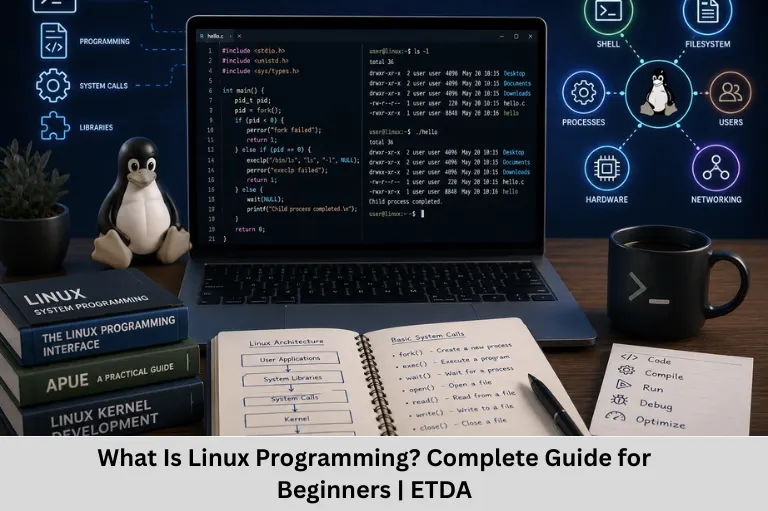
Learn Linux programming from basics to advanced concepts, including shell commands, processes, system calls, files, permissions, IPC, threads, and embedded Linux. Embedded Tech Development Academy (ETDA).
- What Is Linux Programming? Complete Guide for Beginners | ETDA
-
What Is Linux Programming? A Complete Guide for Beginners
- What Is Linux?
- What Is Linux Programming?
- Linux Command Line
- Linux File System
- Processes in Linux
- System Calls in Linux
- Inter-Process Communication in Linux
- Threads in Linux
- Linux Shell Scripting
- Linux Networking and Socket Programming
- Linux Compilation and Build Tools
- Linux Device Drivers
- Embedded Linux Programming
- Linux Programming vs Embedded C Programming
- Applications of Linux Programming
- Skills Required to Learn Linux Programming
- Learn Linux and Embedded Systems at ETDA
-
Assured Placement Support at ETDA
- Placement Preparation
- FAQs
- What is Linux programming?
- Which programming language is commonly used for Linux system programming?
- What are system calls in Linux?
- What is the difference between Linux programming and Embedded C?
- What is IPC in Linux?
- Is Linux programming useful for embedded systems?
- What should I learn before Embedded Linux?
- What tools are commonly used for Linux programming?
- Does ETDA provide placement support?
- Why learn Linux at ETDA?
- Conclusion
What Is Linux Programming? A Complete Guide for Beginners
Linux programming is the process of developing, compiling, executing, debugging, and managing software on a Linux-based operating system. Unlike programming that focuses only on a particular application language, Linux programming also involves understanding the operating system, processes, files, memory, permissions, system calls, networking, and development tools.
Linux is especially important in embedded systems, servers, networking equipment, automotive platforms, Internet of Things (IoT) gateways, cloud infrastructure, and industrial devices. Engineers working with embedded Linux need to understand both programming and operating-system concepts.
For engineering students searching for a Top Embedded Training Institute in Bangalore, learning Linux alongside C, C++, Embedded C, data structures, microcontrollers, and operating-system concepts can create a strong technical foundation. Embedded Tech Development Academy (ETDA) focuses on practical embedded technologies and provides assured placement support to help learners prepare for industry opportunities.
What Is Linux?
Linux is an open-source operating system kernel originally created by Linus Torvalds. In everyday usage, the term “Linux” commonly refers to complete operating-system distributions built around the Linux kernel, such as Ubuntu, Debian, Fedora, and others.
The Linux kernel manages hardware resources and provides essential services to applications.
Major Responsibilities of the Linux Kernel
The kernel manages:
- CPU scheduling
- Memory management
- File systems
- Device drivers
- Networking
- Process management
- Inter-process communication
- Security and permissions
Linux Architecture
A simplified Linux architecture can be represented as:
Hardware → Linux Kernel → System Libraries → Shell/Applications → User
Why Linux Matters in Embedded Systems
Embedded Linux is widely used when an embedded product needs more functionality than a small bare-metal microcontroller application can conveniently provide.
Examples include:
- Internet of Things (IoT) gateways
- Network devices
- Smart displays
- Industrial controllers
- Automotive infotainment
- Robotics platforms
- Multimedia devices
What Is Linux Programming?
Linux programming involves writing software that runs within the Linux environment and interacts with operating-system services.
It can include:
- C/C++ application development
- Shell scripting
- System programming
- Process management
- Thread programming
- File handling
- Socket programming
- Inter-process communication
- Device-driver development
- Embedded Linux development
Linux Programming Languages
Several programming languages can be used on Linux.
Common Languages
- C
- C++
- Python
- Shell scripting
- Rust
- Java
- Go
Why C Is Important
C is particularly important for Linux system programming because the Linux kernel itself is predominantly written in C, with architecture-specific components and other parts using additional languages.
C also provides direct access to memory and operating-system interfaces through system calls.
Linux Command Line
The command line is one of the most important tools for Linux programmers.
A shell provides an interface through which users can execute commands and programs.
Common Linux Commands
File and Directory Commands
pwd
ls
cd
mkdir
cp
mv
rm
For example:
mkdir project
cd project
creates a directory and moves into it.
File Viewing Commands
Common commands include:
cat
less
head
tail
These commands are useful for examining source files, logs, configuration files, and program output.
Why Command-Line Skills Matter
Linux development frequently involves compiling programs, managing files, checking processes, viewing logs, configuring systems, and debugging applications from the terminal.
Linux File System
Linux uses a hierarchical file system.
The root directory is represented by /.
Important Directories
Some commonly encountered directories include:
/bin/etc/home/usr/var/dev/proc/tmp
/dev
The
/devdirectory contains interfaces representing many devices.Embedded Linux developers frequently interact with device-related interfaces while testing hardware.
/proc
The /proc virtual file system provides information about processes and kernel/system state.
For example:
cat /proc/cpuinfocan display processor-related information.
File Permissions
Linux uses permissions to control access to files and directories.
Permissions generally include:
- Read
- Write
- Execute
They can be assigned to:
- Owner
- Group
- Others
Processes in Linux
A process is a running instance of a program.
When a program starts, Linux creates a process and assigns resources required for execution.
Process States
A process can move through different states depending on its execution.
Common concepts include:
- Running
- Waiting
- Stopped
- Terminated
Process Identification
very process has a Process ID (PID).
Commands such as:
psand
topcan be used to inspect running processes.
Process Creation
Linux provides mechanisms such as fork() for creating processes.
A simplified C example is:
#include <stdio.h>
#include <unistd.h>

int main(void)
{
    fork();
    printf("Process running\n");
    return 0;
}
The behavior of fork() is an important concept in Linux system programming.
System Calls in Linux
A system call is an interface through which a user-space program requests a service from the Linux kernel.
Common System Calls
Examples include:
open()read()write()close()fork()exec()wait()
Example of File Access
A program can use system calls to open and manipulate files:
int fd = open("data.txt", O_RDONLY);The returned file descriptor can then be used with operations such as read() and close().
User Space and Kernel Space
Linux separates normal applications from privileged kernel operations.
User space contains application programs, while kernel space contains the operating system’s core functionality.
System calls provide a controlled interface between these two areas.
Inter-Process Communication in Linux
Multiple processes sometimes need to exchange data or coordinate their activities.
Linux provides several IPC mechanisms.
Common IPC Mechanisms
- Pipes
- Named pipes
- Message queues
- Shared memory
- Semaphores
- Signals
- Sockets
Shared Memory
Shared memory allows multiple processes to access a common memory region.
It can provide high-performance data exchange, but synchronization is required when multiple processes access shared data concurrently.
Threads in Linux
A thread is an execution path within a process.
Threads within the same process can share resources such as memory and file descriptors.
POSIX Threads
Linux applications commonly use the POSIX threads API, often called pthreads.
Example:
#include <pthread.h>
#include <stdio.h>

void *task(void *arg)
{
    printf("Thread executing\n");
    return NULL;
}

int main(void)
{
    pthread_t thread;

    pthread_create(&thread, NULL, task, NULL);
    pthread_join(thread, NULL);

    return 0;
}
Thread Synchronization
When multiple threads access shared data, synchronization mechanisms may be required.
Common mechanisms include:
- Mutexes
- Semaphores
- Condition variables
Why Thread Programming Matters
Thread programming is useful for applications that need concurrent operations, such as networking, data acquisition, user interfaces, and embedded Linux applications.
Linux Shell Scripting
Shell scripting allows developers to automate Linux tasks.
Basic Shell Script
#!/bin/bash

echo "Linux Programming"
A script can combine multiple commands into an automated workflow.
Applications of Shell Scripts
Shell scripting can automate:
- Software builds
- File operations
- Testing
- System configuration
- Log processing
- Application deployment
Shell Scripting for Embedded Developers
Embedded Linux engineers frequently use shell scripts during system setup, testing, deployment, and debugging.
Linux Networking and Socket Programming
Linux provides extensive networking capabilities.
Socket programming allows applications to communicate across networks.
Common Socket Concepts
A network application may use:
- Socket creation
- Binding
- Listening
- Accepting connections
- Connecting
- Sending data
- Receiving data
- Closing sockets
TCP and UDP
TCP provides connection-oriented, reliable communication, while UDP provides connectionless communication with lower protocol overhead.
Embedded Applications
Socket programming is useful in:
- Internet of Things (IoT) gateways
- Network controllers
- Industrial systems
- Remote monitoring
- Embedded servers
Linux Compilation and Build Tools
Linux provides powerful development tools for compiling and debugging applications.
GCC Compiler
The GNU Compiler Collection (GCC) is commonly used for compiling C and C++ programs.
Example:
gcc main.c -o applicationThe executable can then be run with:
./applicationDebugging with GDB
GDB (GNU Debugger) can help developers:
- Set breakpoints
- Inspect variables
- Step through code
- Examine call stacks
- Identify runtime problems
Build Automation
Tools such as make can automate compilation and help manage projects containing multiple source files.
Linux Device Drivers
Device drivers allow software to communicate with hardware.
Role of a Device Driver
A driver acts as an interface between hardware and higher-level software.
For example, a driver may provide controlled access to:
- GPIO
- UART
- SPI
- I2C
- Sensors
- Displays
- Storage devices
Character and Block Devices
Linux commonly categorizes devices into types such as:
- Character devices
- Block devices
- Network devices
Why Drivers Matter in Embedded Linux
Embedded Linux developers often need to understand drivers when integrating custom hardware with a Linux-based embedded board.
Embedded Linux Programming
Embedded Linux combines the Linux operating system with embedded hardware.
A typical embedded Linux platform may contain:
- ARM processor
- RAM
- Flash/eMMC storage
- Bootloader
- Linux kernel
- Device tree
- Root file system
- Applications
- Device drivers
Embedded Linux Development Flow
A simplified development process is:
Hardware → Bootloader → Linux Kernel → Device Drivers → Root File System → Application
Important Embedded Linux Skills
Engineers should understand:
- C programming
- Linux commands
- Shell scripting
- Cross-compilation
- Boot process
- Device drivers
- Kernel configuration
- Device tree
- Networking
- Debugging
Linux Programming vs Embedded C Programming
Linux programming and Embedded C programming overlap but have different environments.
| Feature | Linux Programming | Embedded C |
|---|---|---|
| Environment | Operating system | Bare-metal/RTOS/embedded environment |
| Memory | Usually larger | Often constrained |
| Hardware access | Through OS interfaces/drivers | Often direct register access |
| Processes | Supported | Usually application-dependent |
| Virtual memory | Common on Linux systems | Usually absent on small MCUs |
| Development | GCC, GDB, Make | Cross-compilers, IDEs, debuggers |
| Applications | System and application software | Firmware and device control |
Understanding both areas is valuable for embedded engineers working with modern connected products.
Applications of Linux Programming
Linux programming is used across many technical domains.
Major Applications
- Embedded Linux
- Servers
- Cloud infrastructure
- Networking
- Internet of Things (IoT)
- Automotive systems
- Robotics
- Industrial automation
- Cybersecurity
- Software development
- System administration
Linux is particularly important when an embedded product needs networking, storage, multimedia, multiple applications, or a sophisticated user interface.
Skills Required to Learn Linux Programming
Beginner-Level Skills
Start with:
- Basic Linux commands
- C programming
- File systems
- Shell scripting
- Compilation
- Debugging
Intermediate Skills
Move toward:
- Processes
- Threads
- IPC
- System calls
- Signals
- Socket programming
- File descriptors
Advanced Skills
Learn:
- Device drivers
- Kernel concepts
- Cross-compilation
- Bootloaders
- Device trees
- Embedded Linux
- Build systems
Recommended Learning Approach
A practical progression is:
C Programming → Linux Commands → System Programming → Processes & Threads → IPC → Networking → Device Drivers → Embedded Linux
Learn Linux and Embedded Systems at ETDA
Embedded Tech Development Academy (ETDA) provides practical, industry-focused training for students and graduates interested in embedded technology.
Technical Training Areas
Learners can develop skills in:
- C Programming
- C++
- Embedded C
- Data Structures
- Linux Programming
- Embedded Linux
- ARM Architecture
- STM32
- LPC1768
- RTOS
- Device Drivers
- UART
- SPI
- I2C
- CAN
- Ethernet
- Internet of Things (IoT)
Practical Project-Based Learning
Practical projects allow students to connect programming concepts with real hardware and operating-system environments. This helps bridge the gap between theoretical knowledge and the skills expected in technical roles.
Assured Placement Support at ETDA
Embedded Tech Development Academy (ETDA) also provides assured placement support for learners preparing for technology and embedded engineering careers.
Placement Preparation
The support can include:
- Resume preparation
- Technical interview preparation
- C and C++ coding practice
- Linux interview questions
- Aptitude preparation
- Mock interviews
- HR interview preparation
- Communication skills
- Career guidance
Combining technical learning with interview preparation can help engineering students become more confident during recruitment processes.
FAQs
What is Linux programming?
Linux programming involves developing and executing software in a Linux environment while using operating-system features such as files, processes, threads, system calls, networking, and IPC.
Which programming language is commonly used for Linux system programming?
C is one of the most important languages for Linux system programming. C++ and other languages are also widely used depending on the application.
What are system calls in Linux?
System calls provide an interface through which user-space applications request services from the Linux kernel, such as file access, process creation, and communication.
What is the difference between Linux programming and Embedded C?
Linux programming generally runs within an operating system and uses kernel-provided interfaces, while Embedded C is commonly used for firmware that directly controls microcontroller hardware, either bare-metal or through an RTOS.
What is IPC in Linux?
IPC, or Inter-Process Communication, refers to mechanisms that allow processes to exchange data and coordinate with each other. Examples include pipes, message queues, shared memory, semaphores, and sockets.
Is Linux programming useful for embedded systems?
Yes. Linux programming is highly relevant to Embedded Linux, IoT gateways, automotive systems, robotics, networking devices, industrial computers, and other processor-based embedded products.
What should I learn before Embedded Linux?
A good foundation includes C programming, Linux commands, data structures, operating-system fundamentals, shell scripting, processes, threads, and basic computer architecture.
What tools are commonly used for Linux programming?
Common tools include GCC, GDB, Make, Git, text editors or IDEs, shell utilities, and system-monitoring tools.
Does ETDA provide placement support?
Yes. Embedded Tech Development Academy (ETDA) provides assured placement support, including resume preparation, technical interview preparation, coding practice, aptitude training, mock interviews, and career guidance.
Why learn Linux at ETDA?
Embedded Tech Development Academy (ETDA) combines Linux programming with C, Embedded C, ARM, Embedded Linux, RTOS, device drivers, communication protocols, and practical projects. This technical approach, together with assured placement support, helps engineering students prepare for embedded software and Linux-based technology careers.
Conclusion
Linux programming is much more than learning terminal commands. It involves understanding how applications interact with the operating system through processes, threads, system calls, files, memory, IPC, networking, and device interfaces.
For embedded engineers, Linux programming becomes especially important when working with powerful processors and Embedded Linux platforms. Knowledge of C, system programming, shell scripting, device drivers, networking, cross-compilation, and debugging provides a strong foundation for developing Linux-based embedded products.
Engineering students who want to build these skills can consider Embedded Tech Development Academy (ETDA) as a practical learning destination. Students searching for a Top Embedded Training Institute in Bangalore can develop Linux, Embedded C, ARM, RTOS, communication protocols, and Embedded Linux skills through hands-on technical training. Embedded Tech Development Academy (ETDA) also provides assured placement support, helping learners prepare for technical interviews and career opportunities in the embedded technology industry.
Author: ETDA Trainers
Experience: 10+ Years of Industry Experience in Embedded Systems, IoT, and Embedded C Programming