
What Is Python Programming? Complete Guide for Beginners | ETDA
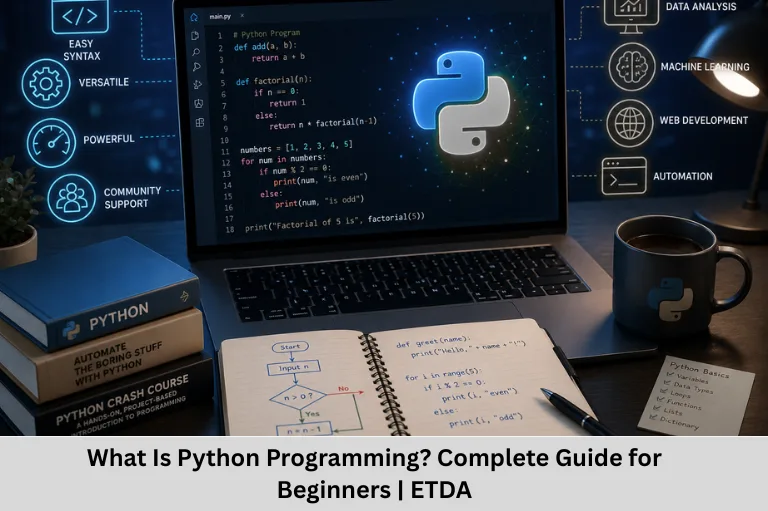
Learn what Python programming is, its syntax, data types, functions, OOP, modules, libraries, applications, and career benefits in this beginner-friendly guide. Embedded Tech Development Academy (ETDA).
- What Is Python Programming? Complete Guide for Beginners | ETDA
-
What Is Python Programming? A Complete Guide for Beginners
- What Is Python Programming?
- How Python Works
- Python Syntax and Indentation
- Variables in Python
- Python Data Types
- Operators in Python
- Conditional Statements in Python
- 3: if Statement
- Loops in Python
- Functions in Python
- Object-Oriented Programming in Python
- Modules and Packages
- Benefits
- Python Libraries and Frameworks
- Python for Embedded Systems and IoT
- Advantages and Limitations of Python
- Applications of Python Programming
- Why Learn Python as an Engineering Student?
- Learn Python and Embedded Technologies at ETDA
-
Assured Placement Support at ETDA
- Placement Preparation
- FAQs
- What is Python programming?
- Is Python easy for beginners?
- What are the main features of Python?
- What are Python's common applications?
- Is Python used in embedded systems?
- Should I learn C before Python?
- What is MicroPython?
- Can Python be used for automation?
- Does ETDA provide placement support?
- Why choose ETDA for Python and Embedded Systems training?
- Conclusion
What Is Python Programming? A Complete Guide for Beginners
Python is a high-level, general-purpose programming language known for its readable syntax, extensive libraries, and versatility. It is widely used in web development, automation, data science, artificial intelligence, machine learning, testing, scripting, and embedded applications.
Unlike low-level programming languages, Python allows developers to express complex operations using relatively simple and readable code. This makes it a popular choice for beginners while still providing powerful features for experienced developers.
For engineering students, Python can complement core programming knowledge gained from C, C++, and Embedded C. It can be used for automation, testing, data processing, development tools, and AI-based applications connected to embedded systems. Students looking for a Top Embedded Training Institute in Bangalore can develop a broader technical foundation through Embedded Tech Development Academy (ETDA), which combines programming concepts with embedded technologies, practical projects, and assured placement support.
What Is Python Programming?
Python is a high-level, interpreted, dynamically typed, general-purpose programming language.
It was created by Guido van Rossum and first released in 1991. Python was designed with an emphasis on readability and developer productivity.
A simple Python program can be written as:
print("Hello, World!")Unlike C, where a basic program requires a main() function and additional syntax, Python allows beginners to perform simple tasks with minimal code.
Key Characteristics of Python
Python provides several important characteristics:
- Simple and readable syntax
- Dynamic typing
- Automatic memory management
- Large standard library
- Extensive third-party ecosystem
- Object-oriented programming support
- Functional programming features
- Cross-platform compatibility
- Rapid development
Why Python Is Popular
Python reduces the amount of code required for many programming tasks. Its readable syntax also makes programs easier to understand, test, and maintain.
Python for Engineering Students
Python is particularly useful for engineering students because it can be applied to programming fundamentals, automation, data analysis, AI, testing, scripting, and embedded development workflows.
How Python Works
Python programs are commonly executed through the Python interpreter.
When a Python program is executed, the source code is generally compiled into an intermediate representation called bytecode, which is then executed by the Python Virtual Machine (PVM) in standard implementations such as CPython.
Python Execution Flow
A simplified execution process is:
Python Source Code → Bytecode → Python Virtual Machine → Program Output
This differs from traditional C compilation, where source code is compiled into native machine code for the target platform.
Interpreted vs Compiled Languages
Python is commonly described as an interpreted language, while C and C++ are generally compiled languages.
However, Python implementations have internal compilation steps, so the distinction is more nuanced than simply saying that Python is “not compiled.”
Python Syntax and Indentation
One of Python’s distinctive features is that indentation defines code blocks.
For example:
age = 20

if age >= 18:
    print("Adult")
The indented statement belongs to the if block.
Why Indentation Matters
In languages such as C and C++, braces {} are commonly used to define blocks.
Python instead uses indentation to make program structure visible.
Benefits
Proper indentation improves:
- Code readability
- Consistency
- Maintainability
- Visual understanding of program structure
Important Rule
Inconsistent indentation can cause Python syntax or indentation errors, so beginners should develop consistent formatting habits from the beginning
Variables in Python
A variable is a name that refers to an object or value.
Example:
name = "Ravi"
age = 21
temperature = 28.5
Python does not require explicit declaration of a variable’s data type before assigning a value.
Dynamic Typing
Python is dynamically typed, meaning the type associated with a variable can change during execution.
value = 10
value = "Python"
The same variable name can refer to objects of different types at different points in a program.
Why This Is Useful
Dynamic typing can make development faster because developers do not need to specify types for every variable.
However, developers must still understand data types to write reliable and maintainable applications.
Python Data Types
Python provides several built-in data types.
Numeric Types
intfloatcomplex
Example:
count = 100
price = 25.50
Boolean Type
The bool type represents:
TrueFalse
Boolean values are commonly used in conditions and decision-making.
String
A string represents a sequence of characters.
message = "Embedded Systems"Python provides numerous operations for working with strings.
List
A list is an ordered, mutable collection.
numbers = [10, 20, 30, 40]Lists can contain different types of objects, although using consistent element types often makes programs easier to maintain.
Tuple
A tuple is an ordered, generally immutable collection.
coordinates = (10, 20)Tuples are useful when a collection should not normally be modified.
Set
A set stores unique elements.
values = {1, 2, 3, 4}Sets are useful for membership testing and removing duplicate values.
Dictionary
A dictionary stores key-value pairs.
student = {
    "name": "Ravi",
    "age": 21
}
Dictionaries are frequently used when information needs to be accessed using meaningful keys.
Operators in Python
Operators allow developers to perform operations on values.
Common Operator Categories
Arithmetic:
+-*/%//**
Comparison:
==!=><>=<=
Logical:
andornot
Assignment:
=+=-=*=
Bitwise Operators
Python also supports:
&|^~<<>>
These are useful when working with binary data and low-level programming concepts.
Conditional Statements in Python
Conditional statements allow programs to make decisions.
if Statement
3: if Statement
temperature = 35

if temperature > 30:
    print("High temperature")
Python also supports:
ifelifelse
Practical Applications
Conditional statements can be used for:
- Sensor threshold checking
- Error handling
- User input validation
- Device status monitoring
- Application logic
Loops in Python
Loops allow developers to execute code repeatedly.
for Loop
A for loop is commonly used to iterate over sequences.
for value in range(5):
    print(value)
while Loop
Python provides:
breakcontinuepass
H5: Why Loops Matter
Loops are fundamental for processing arrays, sensor data, files, collections, and repetitive operations.
Loop Control Statements
Python provides:
breakcontinuepass
Why Loops Matter
Loops are fundamental for processing arrays, sensor data, files, collections, and repetitive operations.
Functions in Python
A function is a reusable block of code designed to perform a particular operation.
Example:
def add(a, b):
    return a + b

result = add(10, 20)
print(result)
Advantages of Functions
Functions improve:
- Code reuse
- Modularity
- Testing
- Maintainability
- Program organization
Function Parameters
Functions can accept:
- Positional arguments
- Keyword arguments
- Default arguments
- Variable-length arguments
Understanding functions is essential before moving to advanced Python programming.
Object-Oriented Programming in Python
Python supports object-oriented programming (OOP).
Classes and Objects
A class defines the structure and behavior of objects.
class Sensor:
    def read(self):
        print("Reading sensor")

sensor = Sensor()
sensor.read()
Here, Sensor is a class and sensor is an object.
Major OOP Concepts
Python supports:
- Encapsulation
- Inheritance
- Polymorphism
- Abstraction
Python and Embedded Software
OOP can be useful for organizing larger software systems, test frameworks, simulation tools, and applications that interact with embedded devices.
Modules and Packages
Python allows programs to be divided into reusable modules.
A module is generally a Python file containing code such as:
- Functions
- Classes
- Variables
Importing Modules
import math

result = math.sqrt(25)
print(result)
Packages can organize multiple related modules into a structured application.
Benefits
Modules and packages promote:
- Code reuse
- Separation of functionality
- Easier maintenance
- Better project organization
Python Libraries and Frameworks
One of Python’s greatest strengths is its extensive ecosystem.
Common Libraries
Depending on the application, developers may use libraries such as:
- NumPy
- Pandas
- Matplotlib
- Requests
- OpenCV
- Scikit-learn
Artificial Intelligence
Python is widely used for AI and machine learning because of its ecosystem of libraries and frameworks.
Automation
Python scripts can automate repetitive tasks such as:
- File processing
- Testing
- Report generation
- Data conversion
- Build processes
Python for Embedded Systems and IoT
Python is not normally used as a replacement for Embedded C in highly resource-constrained microcontroller firmware, but it can play an important role around embedded systems.
Common Applications
Python can be used for:
- Hardware testing
- Automated firmware testing
- Serial communication
- Data analysis
- Internet of Things (IoT) gateways
- Device configuration
- Simulation
- Test automation
MicroPython
MicroPython is a Python implementation designed for microcontrollers and constrained systems.
It allows supported microcontrollers to execute Python-like code directly.
Python vs Embedded C
Embedded C is generally preferred when developers need:
- Precise hardware control
- Deterministic execution
- Maximum performance
- Low memory overhead
Python is useful when:
- Rapid development is important
- Automation is required
- Data processing is involved
- Hardware testing is needed
- The target platform has sufficient resources
Advantages and Limitations of Python
Advantages
- Easy-to-read syntax
- Fast development
- Large ecosystem
- Cross-platform support
- Extensive libraries
- Strong community
- Useful for automation and AI
Limitations
- Generally slower than compiled C/C++
- Higher memory consumption
- Runtime overhead
- Not ideal for all real-time applications
- Standard Python is not suitable for many deeply constrained microcontrollers
Choosing the Right Language
The best programming language depends on the application’s requirements. Embedded developers may use C or C++ for firmware while using Python for testing, automation, data processing, and development tools.
Applications of Python Programming
Python is used across numerous technical domains.
Major Applications
- Web development
- Data science
- Artificial intelligence
- Machine learning
- Automation
- Cybersecurity
- Testing
- Scientific computing
- Internet of Things (IoT)
- Embedded development tools
- Desktop applications
Its versatility makes Python valuable across both software and engineering environments.
Why Learn Python as an Engineering Student?
Python helps engineering students develop programming logic without requiring extensive syntax.
Skills You Can Develop
- Problem solving
- Algorithmic thinking
- Automation
- Data processing
- Object-oriented programming
- File handling
- API interaction
- Testing
Career Benefits
Python knowledge can complement C, C++, Embedded C, data structures, Linux, and embedded systems skills, allowing engineers to work across multiple areas of technology.
Learn Python and Embedded Technologies at ETDA
Embedded Tech Development Academy (ETDA) focuses on practical, industry-oriented technical education.
Technical Foundation
Students can build knowledge in areas such as:
- C Programming
- C++
- Embedded C
- Python
- Data Structures
- Microcontrollers
- ARM Cortex-M
- STM32
- RTOS
- Embedded Linux
- Internet of Things (IoT)
- Communication protocols
Practical Learning
Hands-on projects help students understand how programming concepts are applied to real engineering problems instead of learning programming purely through theory.
Assured Placement Support at ETDA
Technical skills become more valuable when students know how to apply them during recruitment.
Embedded Tech Development Academy (ETDA) provides assured placement support to help learners prepare for embedded and technology-related career opportunities.
Placement Preparation
- Resume preparation
- Aptitude training
- Technical interview preparation
- Coding practice
- Mock interviews
- HR interview preparation
- Communication skills
- Career mentoring
This career-focused approach helps students prepare for both technical assessments and professional interviews.
FAQs
What is Python programming?
Python is a high-level, general-purpose programming language known for its readable syntax, extensive libraries, dynamic typing, and broad range of applications.
Is Python easy for beginners?
Yes. Python’s relatively simple and readable syntax makes it one of the popular languages for beginners. However, mastering advanced Python requires understanding programming concepts, data structures, OOP, modules, exceptions, and software design.
What are the main features of Python?
Important features include dynamic typing, automatic memory management, object-oriented programming, modules, packages, extensive libraries, portability, and readable syntax.
What are Python's common applications?
Python is used for web development, automation, AI, machine learning, data science, testing, scientific computing, IoT, scripting, and embedded development support.
Is Python used in embedded systems?
Yes, but its role depends on the hardware. Python can be used for testing, automation, data processing, IoT gateways, and MicroPython-based microcontroller applications. Embedded C remains important for low-level and resource-constrained firmware.
Should I learn C before Python?
It is not mandatory. However, engineering students interested in embedded systems can benefit from learning C first because it builds a strong understanding of pointers, memory, data types, and low-level programming.
What is MicroPython?
MicroPython is a lightweight implementation of Python designed to run on supported microcontrollers and constrained embedded systems.
Can Python be used for automation?
Yes. Automation is one of Python’s major applications. It can automate file operations, testing, data processing, report generation, device testing, and many repetitive engineering tasks.
Does ETDA provide placement support?
Yes. Embedded Tech Development Academy (ETDA) provides assured placement support, including resume preparation, technical interview training, aptitude preparation, mock interviews, HR interview preparation, and career mentoring.
Why choose ETDA for Python and Embedded Systems training?
Embedded Tech Development Academy (ETDA) combines programming fundamentals with C, C++, Embedded C, Python, data structures, microcontrollers, RTOS, Embedded Linux, Internet of Things (IoT), practical projects, and assured placement support, helping engineering students prepare for industry-oriented technology careers.
Conclusion
Python is a versatile programming language that combines readable syntax, extensive libraries, dynamic typing, object-oriented programming, and rapid development capabilities. Its applications range from automation and web development to artificial intelligence, data science, testing, Internet of Things (IoT), and embedded development tools.
For engineering students, learning Python alongside C, C++, Embedded C, data structures, microcontrollers, and Linux can create a strong technical foundation. In embedded engineering, Python can complement firmware development by supporting automated testing, data processing, device configuration, simulation, and Internet of Things (IoT) applications.
Students searching for a Top Embedded Training Institute in Bangalore can consider Embedded Tech Development Academy (ETDA) for practical and industry-oriented learning. Embedded Tech Development Academy (ETDA) combines programming fundamentals, embedded technologies, hardware-based projects, and assured placement support to help students develop technical skills and prepare for careers in the embedded technology industry.
Author: ETDA Trainers
Experience: 10+ Years of Industry Experience in Embedded Systems, IoT, and Embedded C Programming