
Why C++ Is Essential for Embedded Systems Development | ETDA
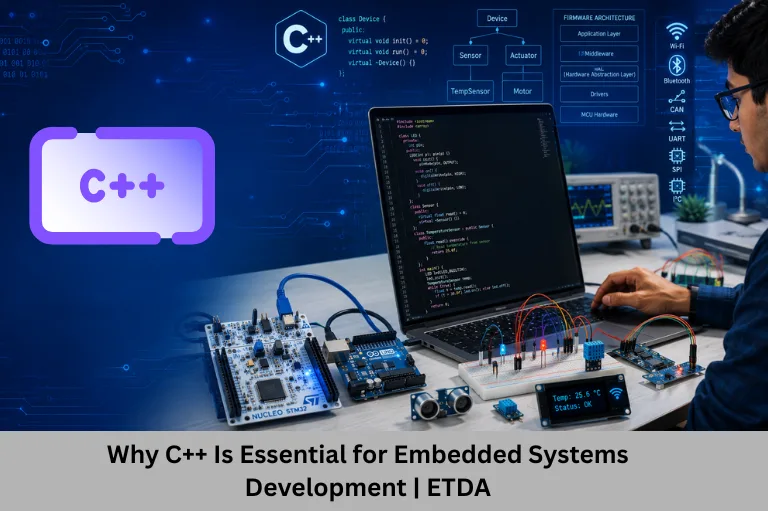
Learn why C++ is essential for embedded systems development, its advantages, career opportunities, and how Embedded Tech Development Academy (ETDA) prepares students with assured placement support.
- Why C++ Is Essential for Embedded Systems Development | ETDA
-
Why C++ Is Essential for Embedded Systems Development
- What Is C++ in Embedded Systems?
- Why C++ Is Becoming the Preferred Language for Embedded Development
- Major Advantages of Using C++ in Embedded Systems
- C++ Features That Benefit Embedded Developers
- Industries That Use C++ for Embedded Systems
- Why Companies Prefer Embedded Engineers with C++ Skills
- Career Opportunities After Learning Embedded C++
- Essential Skills Every Embedded C++ Developer Should Learn
- Why Learn Embedded C++ at Embedded Tech Development Academy (ETDA)?
-
Frequently Asked Questions (FAQs)
- Is C++ necessary for embedded systems development?
- Can I learn embedded systems without knowing C++?
- Which industries hire embedded C++ developers?
- What are the prerequisites for learning embedded C++?
- Why should I choose ETDA for embedded systems training?
- Does ETDA provide practical project experience?
- What is the average career scope after learning embedded C++?
- How long does it take to become job-ready in embedded systems?
- Conclusion
Why C++ Is Essential for Embedded Systems Development
Embedded systems are powering almost every modern electronic device we use today. From smartphones and automobiles to industrial automation, robotics, healthcare devices, and Internet of Things (IoT) products, embedded technology has become the backbone of innovation. While the C programming language remains the foundation of embedded programming, C++ has become increasingly important for developing modern, scalable, and efficient embedded applications.
With growing demand for connected devices and intelligent systems, companies now prefer engineers who possess strong C++ programming skills alongside embedded concepts. Learning C++ not only improves coding efficiency but also enables developers to build reusable, maintainable, and high-performance applications.
If you’re planning to build a successful career in embedded systems, mastering C++ is no longer optional—it is becoming a necessity. This is why students looking for the Top Embedded Training Institute in Bangalore often choose Embedded Tech Development Academy (ETDA), where industry-oriented training, live projects, and assured placement support prepare learners for real-world embedded development.
What Is C++ in Embedded Systems?
C++ is an extension of the C programming language that introduces powerful programming features such as:
Object-Oriented Programming (OOP)
Object-Oriented Programming allows developers to organize code into reusable objects and classes. This makes embedded software easier to maintain as projects become larger.
Data Abstraction
Abstraction hides unnecessary implementation details while exposing only essential functionality, making embedded applications cleaner and more reliable.
Encapsulation
Encapsulation protects data from unintended modifications by grouping related variables and functions together.
Inheritance
Developers can reuse existing code by creating new classes from existing ones, reducing development time.
Polymorphism
Different hardware modules can be controlled using common interfaces, making embedded applications flexible and scalable.
Unlike many high-level programming languages, C++ still provides low-level hardware access, making it ideal for embedded systems where performance and memory efficiency are critical.
Why C++ Is Becoming the Preferred Language for Embedded Development
As embedded systems continue to evolve, software complexity is increasing rapidly.
Modern embedded applications include:
- Automotive Electronics
- Electric Vehicles
- Medical Devices
- Smart Home Systems
- Consumer Electronics
- Industrial Automation
- Robotics
- Aerospace Systems
- Internet of Things (IoT)
Managing these complex applications using only procedural programming becomes challenging. C++ simplifies software architecture while maintaining excellent execution speed.
Major Advantages of Using C++ in Embedded Systems
1. Better Code Reusability
One of the biggest strengths of C++ is code reuse.
Why It Matters
Instead of writing similar code repeatedly, developers can create reusable classes and libraries.
Example
A UART communication class can be reused across multiple STM32 or ARM Cortex projects with minimal modifications.
Benefits include:
- Faster development
- Easier maintenance
- Reduced debugging
- Improved productivity
2. Improved Software Organization
Large embedded projects often involve thousands of lines of code.
Without proper organization:
- Code becomes difficult to debug.
- Development slows down.
- Collaboration becomes harder.
C++ solves this problem using classes and modular programming.
Developers can separate different functionalities such as:
- Sensor Management
- Motor Control
- Communication Protocols
- User Interface
- Memory Management
Each module becomes easier to test and update independently.
3. High Performance
Embedded devices usually have limited resources such as:
- RAM
- Flash Memory
- CPU Speed
- Power Consumption
Unlike many modern programming languages, C++ compiles directly into machine code.
Advantages include:
- Faster execution
- Lower latency
- Better memory utilization
- High computational efficiency
This makes C++ suitable for real-time embedded applications.
4. Excellent Hardware Control
Embedded software frequently interacts with:
- GPIO
- Timers
- UART
- SPI
- I2C
- ADC
- PWM
- CAN
- USB
C++ provides direct access to hardware registers while still supporting modern programming practices.
Developers can create reusable hardware abstraction layers (HALs) that simplify hardware management across different projects.
5. Easier Maintenance
Industrial embedded products often remain in use for several years.
Software updates become inevitable.
A well-designed C++ application is:
- Easier to understand
- Easier to modify
- Easier to upgrade
- Easier to test
This significantly reduces long-term development costs.
C++ Features That Benefit Embedded Developers
Several advanced C++ features make embedded programming more efficient.
Templates
Templates allow developers to write generic code that works with multiple data types without duplication.
Example applications include:
- Communication drivers
- Buffer management
- Mathematical libraries
Namespaces
Namespaces prevent naming conflicts when multiple libraries are integrated into a project.
This becomes extremely useful in large embedded firmware projects.
Constructors and Destructors
These automatically initialize and clean up hardware resources.
For example:
- Initializing peripherals
- Configuring GPIO pins
- Starting communication interfaces
- Releasing allocated memory
This reduces programming errors.
Inline Functions
Inline functions improve execution speed by minimizing function call overhead, which is especially useful in time-critical embedded applications.
Standard Template Library (STL)
Although not every embedded application uses the full STL due to memory constraints, selected containers and algorithms can improve productivity in systems with sufficient resources.
Industries That Use C++ for Embedded Systems
Today, C++ is widely used across industries that require reliable, high-performance software.
Automotive Electronics
C++ powers advanced driver assistance systems (ADAS), engine control units (ECUs), infotainment systems, battery management systems for EVs, and autonomous driving technologies.
Industrial Automation
Factories rely on C++ for PLCs, robotic arms, machine vision systems, CNC machines, and industrial controllers where real-time performance is essential.
Internet of Things (IoT)
Internet of Things (IoT) devices such as smart meters, home automation products, wearable devices, and environmental monitoring systems use C++ to ensure efficient communication and low power consumption.
Medical Devices
Critical healthcare equipment including patient monitoring systems, infusion pumps, ventilators, and diagnostic devices require reliable embedded software, making C++ an ideal choice.
Why Companies Prefer Embedded Engineers with C++ Skills
The embedded industry is evolving rapidly, and employers are looking for engineers who can build reliable, scalable, and maintainable software. While C remains a core language for low-level programming, C++ adds modern programming capabilities that simplify large-scale embedded projects.
Organizations developing automotive systems, industrial controllers, Internet of Things (IoT) devices, robotics, and consumer electronics increasingly expect candidates to understand both C and C++. Engineers who can write modular firmware, optimize performance, and maintain clean code are highly valued because they contribute to faster product development and long-term software reliability.
Some of the key reasons companies prefer C++ developers include:
- Faster software development through reusable code
- Better organization for large firmware projects
- Improved maintainability and debugging
- Efficient memory management
- Compatibility with existing C-based embedded applications
- Strong support for object-oriented design
As embedded technology becomes more advanced, C++ proficiency gives candidates a competitive advantage during technical interviews and on the job.
Career Opportunities After Learning Embedded C++
Learning C++ opens doors to a wide range of career opportunities across multiple industries. Since embedded software powers billions of electronic devices, skilled professionals remain in high demand.
Popular Job Roles
After mastering embedded C++, you can pursue roles such as:
Embedded Software Engineer
Develop firmware for microcontrollers, processors, and embedded hardware platforms.
Embedded Systems Developer
Design complete embedded applications, integrating both hardware and software.
IoT Developer
Build connected devices that communicate using protocols like MQTT, BLE, Wi-Fi, Zigbee, and LoRa.
Automotive Embedded Engineer
Develop software for Electronic Control Units (ECUs), Advanced Driver Assistance Systems (ADAS), electric vehicles, and infotainment systems.
Firmware Engineer
Write and optimize low-level firmware for sensors, communication interfaces, and real-time applications.
Robotics Engineer
Develop intelligent robotic systems using embedded processors and real-time operating systems.
Embedded Test Engineer
Validate firmware functionality, perform debugging, and ensure product quality before deployment.
Essential Skills Every Embedded C++ Developer Should Learn
To build a successful career, learning C++ alone is not enough. Employers seek engineers with practical exposure to industry-standard tools and technologies.
Core Programming Skills
- C Programming
- C++ Programming
- Data Structures
- Object-Oriented Programming
- Memory Management
- Pointers and References
- File Handling
- Exception Handling
Embedded Development Skills
- Embedded C
- Microcontroller Programming
- ARM Cortex-M Architecture
- STM32 Development
- LPC Microcontrollers
- Peripheral Programming
- GPIO, UART, SPI, I2C, CAN, ADC, PWM
- Interrupt Handling
- Timers and Counters
Advanced Embedded Skills
- Real-Time Operating Systems (RTOS)
- Embedded Linux Basics
- Device Drivers
- Bootloaders
- IoT Fundamentals
- Debugging Techniques
- Version Control using Git
- Hardware Interfacing
- Embedded Project Development
Practical experience with these technologies significantly improves employability and prepares candidates for real-world development environments.
Why Learn Embedded C++ at Embedded Tech Development Academy (ETDA)?
Choosing the right training institute plays a crucial role in shaping your career. If you’re searching for the Top Embedded Training Institute in Bangalore, Embedded Tech Development Academy (ETDA) stands out by offering industry-focused training designed to meet current hiring requirements.
Unlike traditional classroom programs that focus only on theory, ETDA emphasizes practical learning through hands-on labs, real-time projects, and expert mentorship. Students gain experience working with industry-standard development boards, debugging tools, and embedded software workflows, helping them build confidence before entering the job market.
Industry-Oriented Curriculum
The curriculum is regularly updated to reflect the latest industry trends and technologies. Students learn:
- C Programming
- Advanced C++
- Embedded C
- ARM Cortex-M Programming
- STM32 Microcontrollers
- RTOS
- Embedded Linux
- Device Drivers
- IoT Fundamentals
- Live Project Development
Practical Learning Through Projects
Learning becomes more effective when concepts are applied to real hardware. Embedded Tech Development Academy (ETDA) provides opportunities to work on projects such as:
- Smart Home Automation
- IoT-Based Monitoring Systems
- Industrial Automation Applications
- Automotive Embedded Projects
- Sensor Interfacing
- Communication Protocol Implementation
These projects help students strengthen their technical knowledge while building an impressive portfolio.
Expert Faculty and Personalized Guidance
Experienced trainers with industry backgrounds mentor students throughout the program. They provide individual guidance, code reviews, debugging support, and interview preparation to ensure learners are industry-ready.
Assured Placement Support
One of the biggest advantages of choosing Embedded Tech Development Academy (ETDA) is its assured placement support. The academy helps students transition from learning to employment through:
- Resume building
- Mock technical interviews
- Aptitude and HR interview preparation
- Soft skills training
- Company-specific interview guidance
- Placement assistance with hiring partners
This structured approach significantly improves students’ confidence and increases their chances of securing rewarding roles in embedded systems.
Frequently Asked Questions (FAQs)
Is C++ necessary for embedded systems development?
Yes. While C is fundamental, C++ is increasingly used in modern embedded applications because it supports object-oriented programming, modular design, code reuse, and better maintainability.
Can I learn embedded systems without knowing C++?
You can begin with C programming, but learning C++ will greatly improve your ability to work on large and complex embedded projects and increase your job opportunities.
Which industries hire embedded C++ developers?
Embedded C++ developers are hired in automotive, IoT, robotics, industrial automation, healthcare, aerospace, telecommunications, and consumer electronics industries.
What are the prerequisites for learning embedded C++?
Basic programming knowledge is helpful. Most learners start with C programming before moving on to C++, microcontrollers, and embedded systems concepts.
Why should I choose ETDA for embedded systems training?
ETDA offers an industry-aligned curriculum, experienced trainers, hands-on projects, modern lab facilities, interview preparation, and assured placement support, helping students become job-ready.
Does ETDA provide practical project experience?
Yes. Students work on real-time embedded and IoT projects involving ARM, STM32, Embedded Linux, RTOS, and hardware interfacing to gain practical industry exposure.
What is the average career scope after learning embedded C++?
Skilled embedded C++ professionals can pursue careers as Embedded Software Engineers, Firmware Engineers, IoT Developers, Automotive Embedded Engineers, Robotics Engineers, and Embedded Test Engineers, with strong demand across technology-driven industries.
How long does it take to become job-ready in embedded systems?
With consistent learning and hands-on practice, most students can become job-ready within a few months through a comprehensive training program that includes programming, microcontrollers, RTOS, projects, and interview preparation.
Conclusion
C++ has become an indispensable language for modern embedded systems development. Its combination of high performance, object-oriented design, code reusability, and efficient hardware interaction makes it the preferred choice for developing reliable and scalable embedded applications.
As industries continue to adopt advanced technologies such as Internet of Things (IoT), robotics, industrial automation, and electric vehicles, the demand for engineers skilled in embedded C++ will continue to grow.
If you’re serious about building a successful career in embedded systems, invest in practical training that goes beyond textbooks. Embedded Tech Development Academy (ETDA) equips aspiring engineers with in-demand technical skills, hands-on project experience, and assured placement support, making it an excellent choice for anyone looking to launch or advance a career in embedded systems.
Author: ETDA Trainers
Experience: 10+ Years of Industry Experience in Embedded Systems, IoT, and Embedded C Programming